Reading the City Like a Script: Shinjuku's Hidden Visual Grammar in Anime
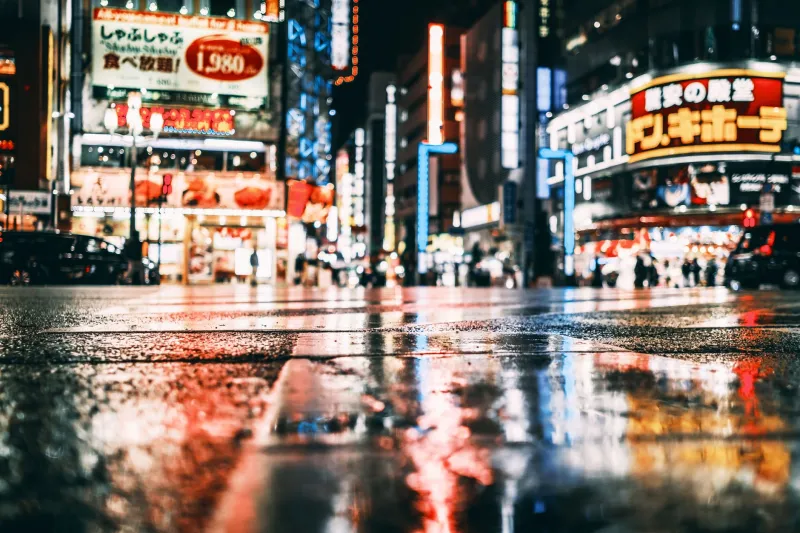
There's a shot you've seen a hundred times without knowing it. A lone figure standing at a crosswalk, rain-slicked pavement reflecting a smear of pink and gold neon, towers of glass receding into fog somewhere behind them. You feel something when you see it — weight, isolation, the sense that something important is about to happen or just finished happening. What you might not realize is that the feeling isn't accidental. It's architectural. It's Shinjuku, and it's been doing that to you on purpose.
Anime directors and background artists have spent decades turning one of Tokyo's most chaotic districts into something closer to a visual instrument. The streets, the lights, the sightlines — all of it has been mapped, catalogued, and deployed with a precision that most viewers never consciously register but absolutely feel. Understanding how that works doesn't just make you a smarter viewer. It reframes everything you thought you knew about how anime communicates.
The District That Does Half the Director's Job
Shinjuku is genuinely unlike anywhere else in Tokyo — and that's not just tourist-brochure talk. Within a few square miles, you've got the hyper-commercial chaos of the east side, the gleaming corporate monolith energy of the west exit skyscrapers, the dense residential tangle of Shinjuku Ni-chome, and the unhinged nightlife labyrinth of Kabukicho. That tonal range packed into a single district gives directors an almost unfair amount of narrative real estate to work with.
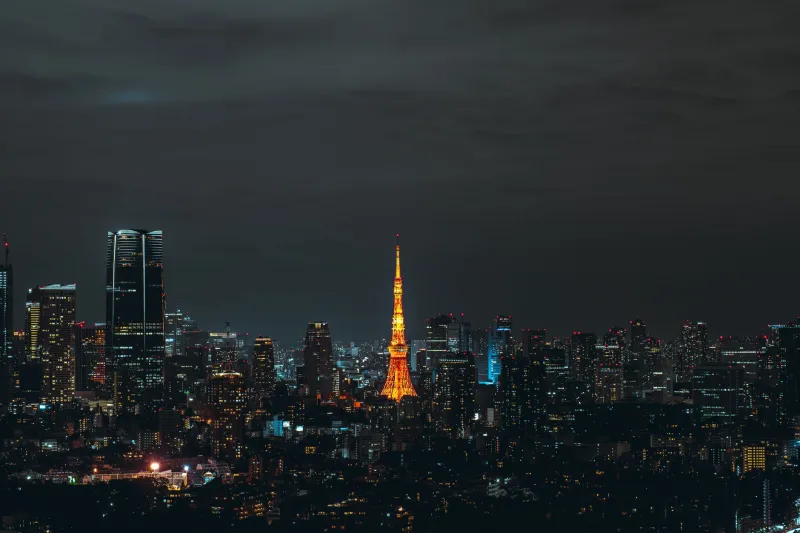
Background artists who've worked on productions set in the area have talked in interviews and industry panels about how the geography essentially pre-loads emotional context. The west exit — all brutalist concrete and wind tunnels between towers — reads as institutional, cold, and transactional. Drop a character there and you've already told the audience something about their headspace without a single line of dialogue. The east side, by contrast, is density and noise and competing stimuli. It's overwhelming in a way that mirrors psychological states like anxiety, excitement, or the particular vertigo of being young and completely lost.
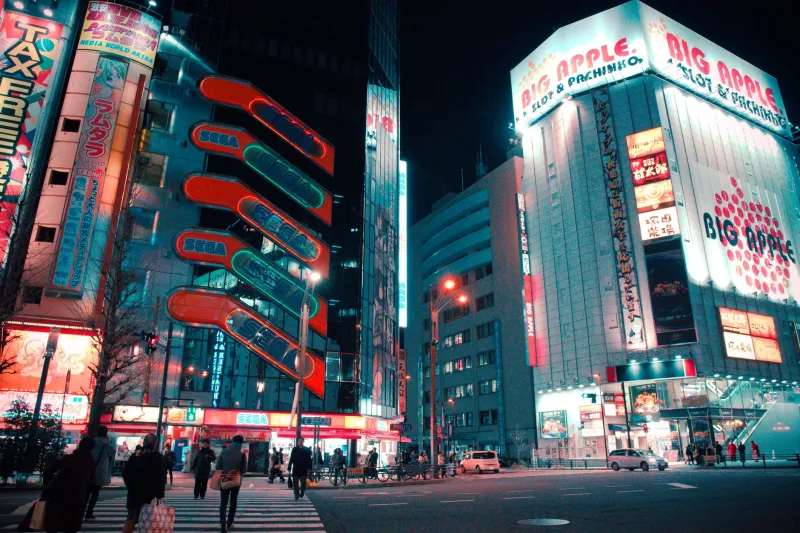
Kabukicho operates as its own grammar entirely. The layered signage, the vertical compression of neon, the way light sources compete and bleed into each other — background artists don't just reference photos of that neighborhood, they study it the way painters study light. The goal isn't photorealism. It's emotional accuracy. What does Kabukicho feel like at 11pm? That's what ends up on screen, and it carries meaning that fans absorb almost subliminally.
Shorthand That Crosses Series
Here's where it gets genuinely fascinating: certain Shinjuku locations have developed consistent meaning across unrelated anime series, almost like a shared visual dictionary that the industry built without ever formally agreeing on it.
The east exit scramble crossing — Shinjuku's answer to Shibuya's famous intersection — shows up repeatedly in scenes of transition and decision. Characters crossing it are typically moving toward something uncertain. Characters standing still while crowds stream past them are usually processing a loss or revelation. It's not a rule anyone wrote down, but watch enough anime and you start to notice the pattern.
The Golden Gai area, those impossibly narrow alleys crammed with tiny bars, tends to appear in scenes of confession, backstory, and emotional vulnerability. There's something about the compressed scale and the warm amber light that signals intimacy. Showrunners and storyboard artists have noted in interviews that tight, human-scale spaces read as emotionally safe in ways that open urban environments simply don't. Golden Gai is essentially a visual cue that says: what happens here stays here, and it matters.
The observation decks of the west exit skyscrapers — particularly the Tokyo Metropolitan Government Building, which appears in more anime than most people realize — carry a different weight entirely. Height in visual storytelling traditionally signals perspective, reckoning, and confrontation with scale. When a character ends up on one of those decks, something is about to shift. The city laid out below them is almost always a metaphor for the problem they're trying to solve or the life they're trying to understand.
What Background Artists Are Actually Doing
It's worth pausing on the craft itself, because the people doing this work don't get nearly enough credit. Background art in anime is one of those disciplines that's invisible when it's done well and only noticed when something feels off. The best background artists working with Shinjuku-based material are essentially doing urban cinematography — they're making choices about what to include, what to simplify, what to exaggerate, and what to light in ways that serve the emotional logic of the scene.
The neon in Kabukicho, for example, is never just neon. The color temperature, the density, the way it interacts with rain or fog — all of that is a deliberate choice. Cooler blues and purples tend to show up in scenes of alienation or moral ambiguity. Warmer pinks and oranges track with scenes of connection or nostalgia. Rain multiplies all of it, scattering light across surfaces in ways that make the environment feel more alive and more unstable simultaneously. It's not a coincidence that so many emotionally pivotal anime scenes are set in Shinjuku in the rain at night. That specific combination is a maximally expressive environment, and artists know it.
Training Your Eye as a Viewer
Once you start seeing the grammar, it becomes hard to unsee — but in a good way. Watching anime set in Shinjuku with this framework in mind adds a layer of engagement that purely plot-focused viewing misses entirely. You start to notice when a director is using the west exit towers to make a character feel small and institutional versus when they're using the same architecture to signal ambition and scale. You catch the difference between Kabukicho rendered in its full chaotic glory versus a quieter, more selective version of the same streets that signals a character retreating from the world rather than engaging with it.
This is genuinely useful for American viewers who didn't grow up with the physical space as a reference point. You don't need to have stood at the Shinjuku east exit in real life to read what it means in anime — but understanding that the location carries specific connotations gives you a key that a lot of casual viewers are working without.
The City as Co-Author
What makes Shinjuku so durable as an anime setting isn't just that it looks cool, though it absolutely does. It's that the district's actual physical character — its contradictions, its layers, its refusal to be one thing — maps almost perfectly onto the kinds of stories anime tends to want to tell. Stories about identity and transformation, about the tension between individual feeling and collective pressure, about what it means to be young and overwhelmed in a world that's too big and too fast.
Shinjuku didn't become anime's favorite district because it was convenient. It became anime's favorite district because it already spoke the language. Directors and artists just learned to translate.